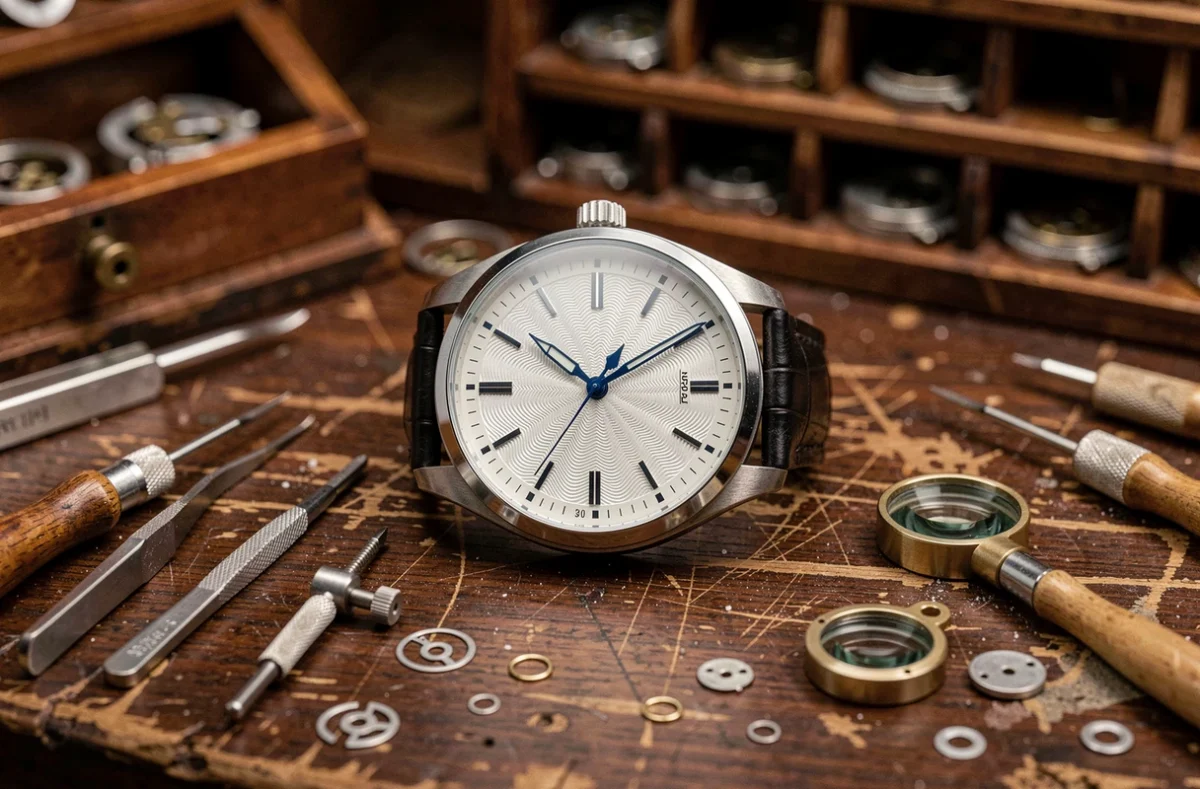
Swiss watchmaking is going through a period of restructuring. Export volumes are stagnating or declining in certain segments, while the total value of exports continues to rise. This divergence reflects a shift in the center of gravity towards high-priced pieces. At the same time, the aesthetic trends of 2026 are redefining wristwatch codes: refined cases, reduced diameters, precise color palettes. The news in the watch industry reflects industrial and commercial decisions that are shaping the market in a lasting way.
Manufactured Movements and Access to Calibers: The Sector’s Fault Line
The major houses are no longer differentiated solely by design or marketing. The ability to produce one’s own caliber is becoming a strategic positioning criterion. An article from WatchPro dated September 2026 describes a growing division in the sector around this issue: on one side, brands capable of designing and manufacturing their movements in-house, and on the other, those that rely on third-party suppliers.
This fracture has direct consequences for buyers. A brand that masters its caliber can control quality, after-sales service timelines, and the availability of spare parts in the long term. For enthusiasts who publish and exchange on platforms like TZ Mag, the origin of the movement has become a topic of discussion as frequent as the choice of material or the finishing of the dial.
Independent brands and small manufacturers face a dilemma: invest heavily in R&D to produce an in-house caliber, or accept a dependency that may limit their maneuverability and image. This tension structures the watch landscape well beyond simple pricing issues.

Swiss Watch Exports: Value Rises, Volumes Stagnate
The contrast between value and the number of pieces exported is one of the most telling signals of the market’s state. Swiss watch exports continue to show rising amounts, but this growth is based on watches sold at higher prices, not on a broader volume of timepieces distributed worldwide.
This phenomenon reflects a growing dependence on high-end segments. Moderately priced steel pieces, which historically formed the backbone of sales, are losing ground proportionally. The risk: increased exposure to economic downturns in the most extravagant markets.
The United States, Primary Outlet and Source of Vulnerability
According to swissinfo.ch, the United States has become the largest market for Swiss watchmaking, with exports nearing 3 billion francs in the first seven months of 2026. This geographical concentration makes the industry particularly sensitive to fluctuations in American demand, whether due to dollar fluctuations, tax changes, or a simple slowdown in luxury consumption.
China, long perceived as the natural growth relay, does not compensate for this dependence. The Chinese market remains marked by regulatory uncertainties and changes in purchasing behavior that are difficult to anticipate.
Second-Hand Watch Market: Selective Recovery, Not Uniform
The secondary market does not follow a homogeneous trajectory. An article from swissinfo.ch in October 2026 reports a 5.5% increase in the Chrono24 price index in the first half of 2026. This growth is primarily driven by three brands: Cartier, TAG Heuer, and Tudor.
The fact that the recovery is concentrated on these references, and not on the entire available catalog, deserves analysis. Several factors can explain this:
- Cartier benefits from sustained demand driven by the growing appeal of watches that are both jewelry and horology, with models like the Santos or the Tank reaching an audience beyond traditional collectors.
- TAG Heuer and Tudor occupy an accessible price segment in the Swiss universe, making them attractive to first-time buyers in the second-hand market.
- Brands whose new prices have risen sharply in recent years see their second-hand value stabilize or decline due to insufficient demand at these levels in the secondary market.
For a buyer, the second-hand value of a watch does not always reflect the quality of the timepiece. It reflects a relationship between the available supply, perceived desirability, and the price of new. A model whose value is decreasing can represent an excellent buying opportunity if the mechanics and finishing are up to standard.

Aesthetic Trends 2026: Slim Cases, Precise Colors, Reduced Diameters
The new releases presented in 2026 by the leading brands converge towards a similar formal register. Cases are slimming, diameters are reducing, and the color of the dial is no longer a detail but a full-fledged axis of differentiation.
Ultra-Thin as a Comfort Argument
The race for thinness is not new, but it is changing in nature. It is no longer just about breaking a thickness record. Brands are working to make ultra-thin calibers wearable on a daily basis, with shock resistance and a power reserve compatible with real use. Progress is measured as much by wrist comfort as by technical prowess.
More Compact Diameters, A Lasting Return
After years of imposing watches, the trend towards contained diameters (under 40 mm) is establishing itself durably. This movement affects both dress watches and sports watches. It responds to a demand for more balanced proportions, driven notably by a clientele that no longer seeks to showcase the size of their timepiece.
On the color palette side, cool tones (frosted blue, slate gray) and matte finishes dominate the 2026 collections. Color serves as a signature: a sage green or midnight blue dial becomes a selection criterion as decisive as the type of movement or the material of the case. The dial replaces diameter as the primary factor of visual identification.
The news in the watch industry of 2026 can be read through these lines of tension: a market that focuses on value rather than volume, brands that separate according to their industrial mastery, a secondary market with uneven recovery, and aesthetic trends that favor subtlety. For enthusiasts, each new release deserves to be placed in this broader context, beyond just the appeal of the dial.