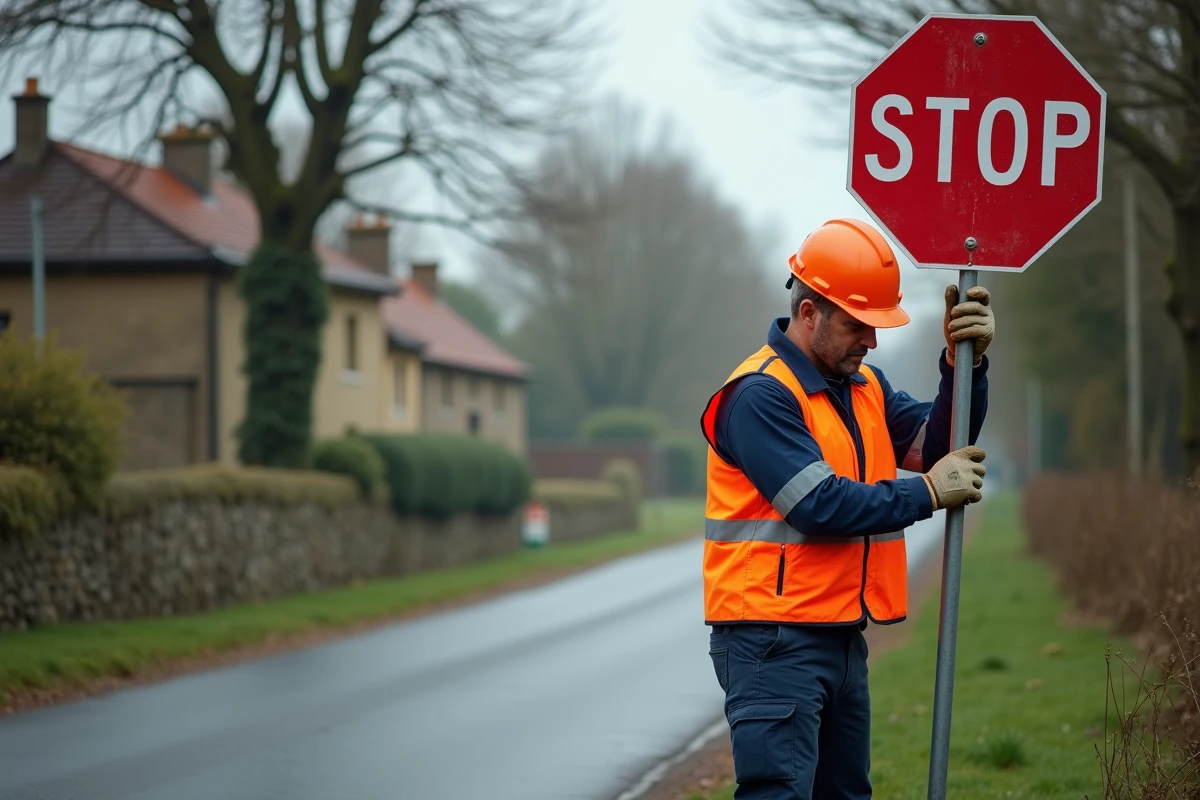
In France, road signage falls under a regulatory framework that goes far beyond the simple Highway Code. Municipalities bear direct responsibility for the installation, maintenance, and compliance of signs on their roads.
This responsibility is based on a normative triptych: the Highway Code (articles R411-1 to R417-13), the interministerial instruction on road signage, and technical standards of the NF type. A poorly placed or absent sign can be enough to annul a municipal order or a ticket.
Municipal boundary sign: an underestimated legal trigger
The municipal boundary sign is not just about displaying the name of the municipality. Its installation automatically triggers the application of all rules related to traffic in built-up areas: default speed limit of 50 km/h, prohibition of horn use except in immediate danger, specific parking rules.
If this sign is absent, poorly positioned, or obscured by vegetation, fines issued on the affected stretch can be contested in court. The municipality then engages its responsibility, not only on an administrative level but also in terms of road safety.
As detailed by Mécamobile, the mayor exercises their traffic police authority over all municipal roads, which includes the installation and maintenance of these entry and exit signs for built-up areas. This competence cannot be delegated without a precise legal framework.

Technical compliance obligation for municipal signage
Local authorities cannot install just any sign, nor can they place it in any manner. Regulations impose precise criteria for readability, mounting height, retro-reflectivity class, and dimensions, depending on the type of road and the permitted speed.
Vertical and horizontal signage must comply with the interministerial instruction, a reference document that details the installation conditions for each category of sign. A non-compliant traffic sign (wrong size, wrong height, lack of appropriate retro-reflectivity) can be declared unenforceable against road users.
- Traffic signs (prohibition, obligation, speed limits) must be based on an order from the mayor or prefect to have legal value
- Road markings (crosswalks, solid lines, zebras) fall under horizontal signage and must be regularly maintained to remain enforceable
- Information and directional signs follow different size and color standards depending on whether they are installed in built-up areas or outside them
A deviation from these rules exposes the municipality to legal disputes. Users who receive fines can contest them, and accident victims can hold the local authority liable for lack of normal road maintenance.
Particular case of the municipal public domain
On the municipal public domain, the mayor is the competent authority regarding signage. On departmental roads crossing the municipality, the situation becomes more complicated: the departmental council remains the owner of the road, but the mayor retains their traffic police authority in built-up areas. This overlap of competencies regularly generates disputes over who should install, maintain, or replace a defective sign.
LOM Law and crosswalks: a concrete deadline for municipalities
The Mobility Orientation Law (LOM) introduced a very concrete obligation. By December 31, 2026, all municipalities must have removed all motor vehicle parking within 5 meters upstream of crosswalks.
This measure requires an immediate update of signage: removal or relocation of parking signs, addition of prohibition signs, modification of road markings. For many small municipalities, this represents a significant roadwork project, with study and installation costs that had not been anticipated in budgets.
Field feedback varies on this point: some local authorities have integrated this obligation into their multi-year road plan, while others discover the deadline late. Failure to comply by the deadline exposes the municipality to liability in the event of an accident at an unsecured crosswalk.
Accessibility and readability of signage on municipal roads
Recent regulations emphasize the accessibility of road signage. Signs must be readable by all users, including individuals with visual or cognitive disabilities.
This concerns character size, color contrast, mounting height, and the absence of visual obstacles (vegetation, street furniture). Municipalities renovating their signage must incorporate these accessibility criteria, under penalty of non-compliance with current regulations.
- Signs installed too low or too high lose their legal enforceability and practical effectiveness
- Vegetation that obscures a sign engages the municipality’s responsibility for lack of maintenance
- Insufficient contrasts on traffic signs reduce the safety of vulnerable users (pedestrians, cyclists)
An unreadable sign is legally equivalent to an absent sign. This rule, regularly reiterated by administrative jurisprudence, requires municipal technical services to schedule inspection and replacement rounds.
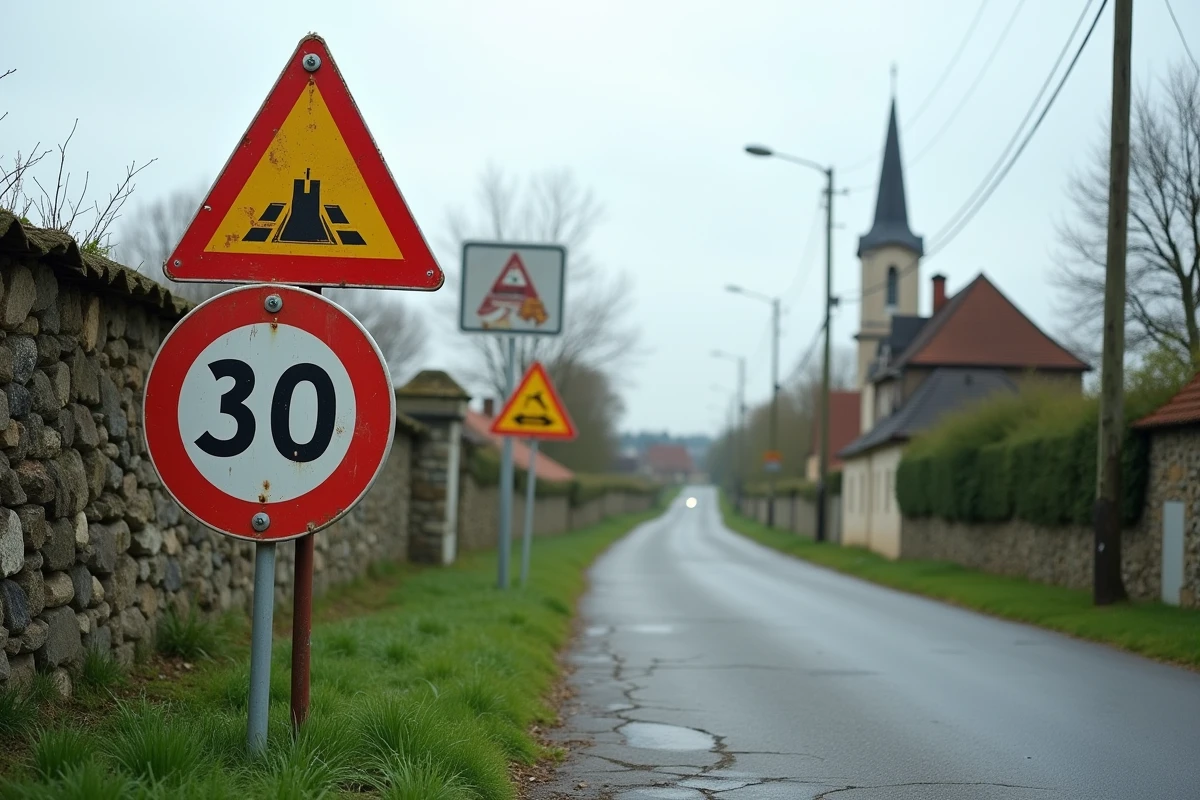
Municipal road signage is not purely a technical subject. It is an issue of legal responsibility, user safety, and regulatory compliance. With the LOM deadline set for the end of 2026, municipalities that have not yet initiated their road diagnostics have a limited timeframe to get in compliance.