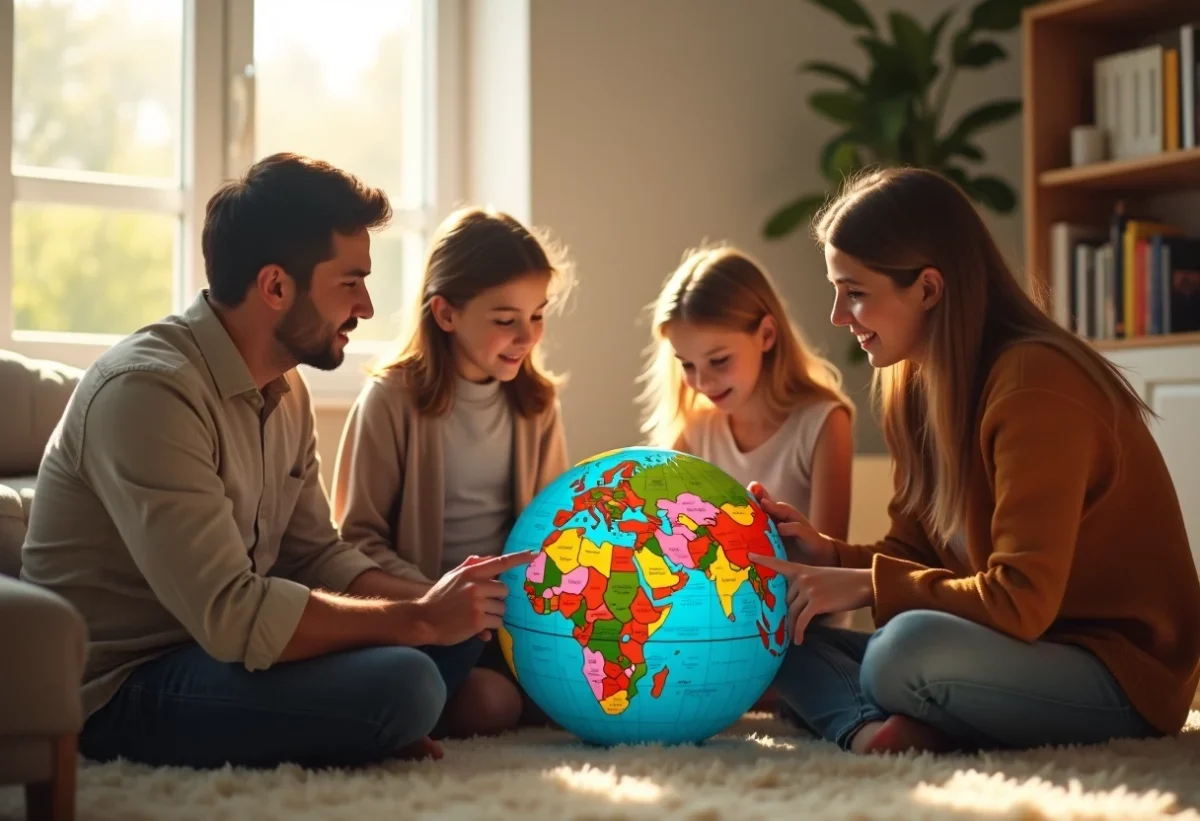
With a simple globe at home, it is possible to turn learning into an exciting adventure. By exploring continents, oceans, and different countries, children can develop a deeper understanding of the world around them. By adding interactive activities, such as searching for capitals or discovering local cultures, the globe becomes a dynamic tool to spark curiosity.
By integrating educational games and geographical challenges, young minds remain engaged and motivated. Whether tracing the routes of famous explorers or studying different time zones, each session with the globe can become an enriching and entertaining experience. The world then opens up to them, one rotation at a time.
Steps to create an engaging educational project with a globe
1. Prepare your materials
To start your project, gather the following items:
- A Montessori globe
- Colored sand to represent the continents
- Blue paint for the oceans
- blank map to print
2. Create a Montessori geography corner
Transform a space in your home into a global exploration center. Follow the principles of Montessori geography to organize this space:
- Use the Montessori globe as the centerpiece
- Arrange the colored sand and blue paint to allow children to visualize and manipulate geographical elements
3. Introduce interactive activities
To make learning captivating, integrate fun activities:
- Use the blank map to print for mapping exercises
- Encourage children to trace the routes of famous explorers
- Offer geographical challenges, such as finding capitals or time zones
4. Follow the Montessori progression
Adopt an appropriate progression:
- Start with sensory life activities, such as manipulating colored sand
- Move on to language activities, naming continents and oceans
- Incorporate math activities, such as calculating distances between two points
By following these steps, you can create an engaging and stimulating educational project for young minds while respecting the principles of Montessori geography.
Ideas for educational activities with a globe
1. Activities pack on continents
Provide children with a pack of activities about continents. This pack includes nomenclature cards, educational puzzles, and various stimulating games. Use these resources to introduce the different continents in a fun and interactive way.
2. Continents puzzle
The continents puzzle is a valuable tool for Montessori geography. Encourage children’s fine motor skills while teaching them the different parts of the world. Children can assemble the puzzle pieces to visualize and memorize the layout of the continents.
3. Country nomenclature cards
Use country nomenclature cards to help children identify and memorize countries and their characteristics. These cards are an excellent complement to the Montessori globe, allowing for a more detailed exploration of various regions of the world.
4. Montessori atlas
Integrate a Montessori atlas into your educational project. This tool allows for an in-depth exploration of different regions of the world, thus enriching children’s geographical knowledge. The atlas provides detailed and visual information that perfectly complements learning with the globe.
5. Montessori progression activities
Adopt a progression suited to children’s abilities. Start with practical and sensory life activities, then move on to language and math. Finish with cultural activities for a comprehensive understanding. This Montessori progression ensures structured and coherent learning.
By integrating these ideas for educational activities, you will transform the learning of geography into a captivating and interactive experience for young minds.