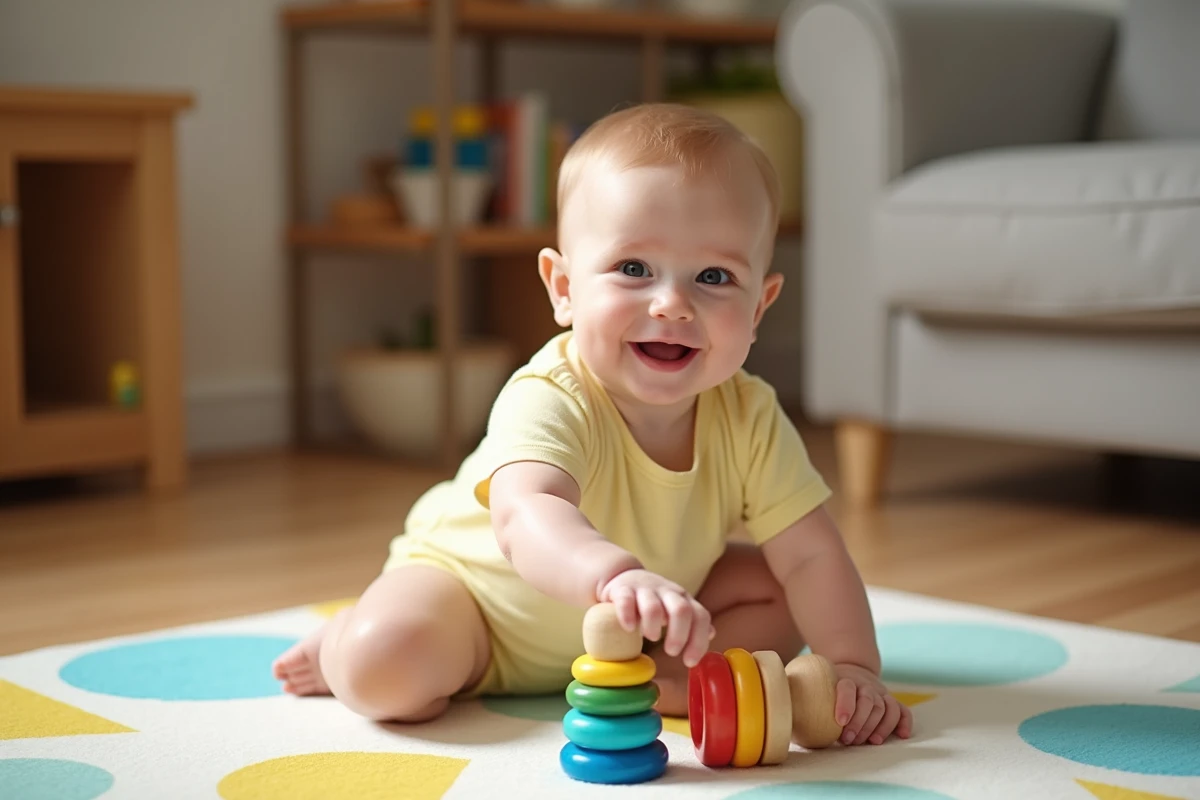
At eight months, a baby is no longer content to just look at the world: they grab it, bring it to their mouth, shake it, and throw it on the ground. Hand-eye coordination progresses quickly, babbling diversifies, and the sitting position opens up a new realm of manipulation.
Offering stimulating activities at this age is less about entertaining than providing an appropriate exploration ground for these emerging skills.
Hand-eye coordination at 8 months: what pouring games reveal
Pouring objects from one container to another may seem trivial. However, for an 8-month-old baby, the exercise engages several circuits simultaneously: visual identification of the object, adjustment of the grip (pincer grasp or whole palm), and voluntary release above the second container. This controlled release, distinct from the grasp reflex of the early months, is a motor marker that health professionals observe during developmental assessments.
Two stainless steel bowls and a few large raw pasta shapes are enough. The size of the pasta matters: each object must be too large to be swallowed, since everything ends up in the mouth at this age. The activity is done on the floor, on a tray, or in a basin to limit spillage. Parents who wish to extend the exploration will find ideas for 8-month-old baby games on Imazine to vary the manipulation supports.

Tummy time after 8 months: why it remains useful for motor skills
Tummy time is often associated with the early months of life. Recent French-speaking pediatric recommendations remind us that supervised tummy time remains beneficial beyond six months. Around eight months, this position supports weight bearing on the hands, pivoting on the floor, and preparation for crawling.
It also plays a role in preventing positional plagiocephaly, a flattening of the skull related to excessive time spent on the back. A baby who spends long periods sitting in a bouncer or stroller does not engage the same muscle chains as one who crawls on a firm surface.
Specifically, placing a sound toy or a colorful object just out of reach while the baby is on their tummy encourages them to pivot, reach out, and sometimes initiate movement. The session can last a few minutes, interrupted as soon as the child shows discomfort.
Sensorial activities and language development at 8 months
The babbling of an eight-month-old baby (“ba-ba,” “da-da,” “ma-ma”) is not language, but it lays the foundations for it. Responding to babbling as if it were a real conversation stimulates language circuits. The parent repeats, rephrases, names the object the baby is holding: this verbal back-and-forth, called “early turn-taking,” is documented as a lever for language development.
Action songs combine auditory stimulation, fine motor skills, and social interaction. The regular rhythm helps the baby anticipate the sequence: they eventually raise their hands even before the parent reaches the chorus. This ability to anticipate is a sign of developing procedural memory.
Everyday objects as sound awakening supports
No need for expensive musical toys. A kitchen whisk shaken in a metal bowl, a wooden spoon tapped on a lid, a crumpled kraft paper bag: these varied sounds feed auditory curiosity and allow the baby to explore the link between their action and the noise produced. The principle of cause and effect is at the heart of cognitive awakening at this age.
Water play and ball games: two activities targeting different skills
Water fascinates most eight-month-old babies. A shallow basin, a few cups, and a warm temperature are enough to create a sensory bath. The baby pours, splashes, and observes the water flowing between their fingers. Supervision remains constant, even with a low water level.
Ball games address another need. A lightweight ball (foam or fabric) rolled towards the sitting baby encourages them to follow it with their eyes, reach out, and sometimes awkwardly send it back. This back-and-forth constitutes one of the first forms of structured social play between parent and child.
- Water develops tactile perception and understanding of physical properties (an object floats or sinks, water flows, fabric absorbs).
- Balls engage visual tracking, hand-eye coordination, and social exchange (waiting, receiving, sending back).
- Both activities enhance gross and fine motor skills in a complementary manner.
Observing the baby’s reactions: early detection and limits of awakening play
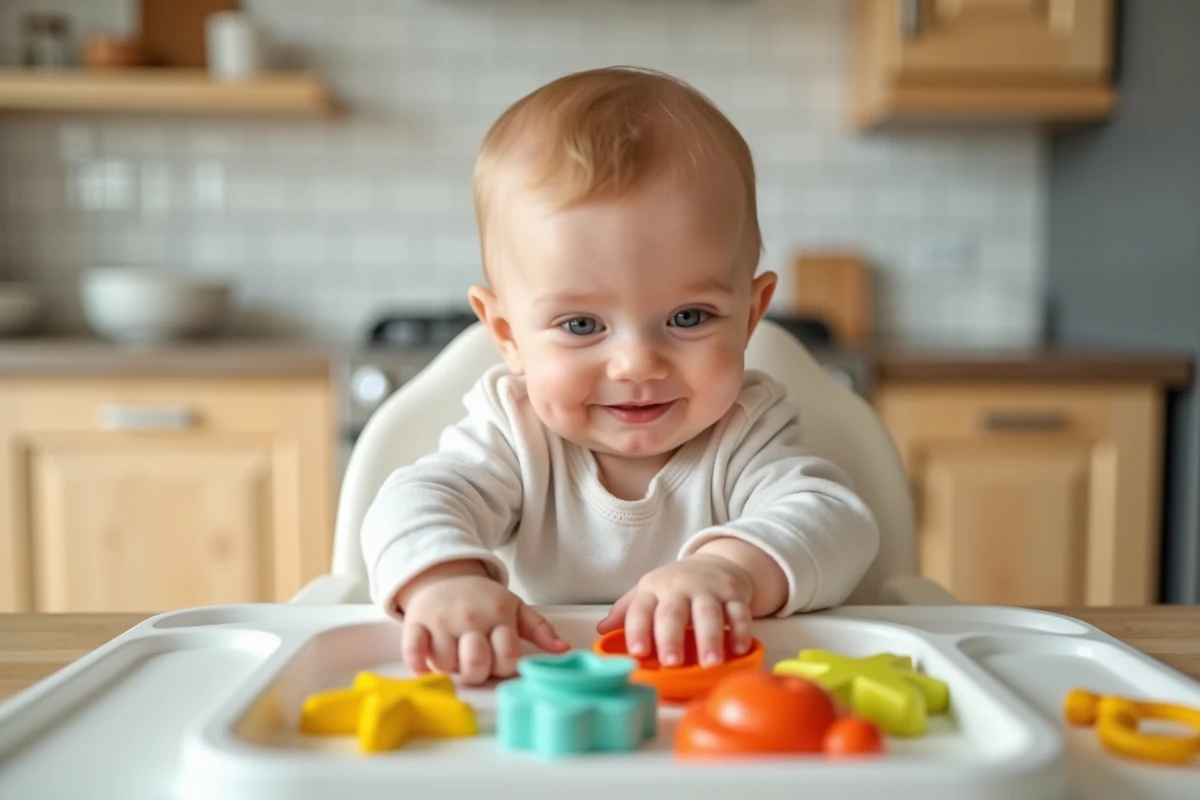
Awakening activities are not just for entertainment or stimulation. They provide a window for observing the baby’s development. The Haute Autorité de Santé and the Société Française de Pédiatrie recommend that parents pay attention to certain signals during floor play from six to nine months.
A fleeting gaze, lack of babbling, or low interest in social interactions during play can be early warning signs of neurodevelopmental disorders. Observing how a baby responds to their name, follows the parent’s gaze, or attempts to imitate an action during a nursery rhyme provides clues that the pediatrician can later contextualize during a consultation.
These observations do not replace a professional assessment. Field reports vary on the boundary between simply slower developmental pace and a signal that warrants a thorough evaluation. The parent’s role is to note what they observe and discuss it with the doctor, not to diagnose based on a ball game.
An eight-month-old baby does not need a structured minute-by-minute program. A few varied activities, offered in a safe environment and interrupted when the child loses interest, cover the essentials of their awakening needs. The best indicator remains the baby’s own interest: if they turn their head away or cry, the play has served its purpose, or it was not the right moment.